How do I choose upholstery fabric?
Judge upholstery fabric on four things. Durability, measured by the Martindale rub test: 15,000 or more for light domestic use, 25,000 general domestic, 40,000 for heavy domestic or light contract, and 100,000 for severe contract. Fire performance, which in the UK means the cover must pass the match test as part of the composite it is fitted with, not on its own. Construction, since a loose weave snags and a tight weave wears. And the practical matter of width and pattern repeat, which decides how much you buy. Colour is the last decision, not the first.
Fabric choice is where customer enthusiasm meets workshop knowledge. The customer is choosing on colour, pattern, hand-feel and price; you need them choosing on those things plus rub rating, fibre composition, pile direction, pattern repeat and trade availability.
Shops: Visualiser Pro does this on your phone in the customer’s front room, with printable choice sheets carrying your own logo and prices.
For domestic work in the UK, run any cloth through the fire regulations checker before you order it.
Torn between fabrics? The free fabric visualiser shows your actual chair re-covered in any fabric from two photos, in about twenty seconds — the cheapest way to rule a cloth in or out before a metre is cut.
The skill is having the technical conversation without dampening anyone’s enthusiasm for the chair — and in our experience most customers are delighted to learn the technical side; it flatters them as participants in the decision. This chapter gives you the whole of that conversation: how to read a label, what the fibres do, what the rub numbers mean, how pattern repeat eats yardage, and how to buy at trade prices instead of retail.
We also keep a shorter PDF guide that covers the same ground in eleven pages, free at greenwoodupholstery.com. This chapter assumes you haven’t read it.
What should you check on an upholstery fabric label?
Five things, all on any reputable trade spec sheet: composition (the fibre breakdown), weight in grams per square metre, the roll width, the rub rating in Martindale or Wyzenbeek cycles, and the pattern repeat. Domestic-shop labels rarely list more than the first — when in doubt, ask.
Every reputable trade-supplied fabric comes with a label or spec sheet listing five things you need to know before you agree to use it: composition (the fibre breakdown), weight in grams per square metre, width of the roll, rub rating in Martindale or Wyzenbeek cycles, and pattern repeat. Every domestic-shop fabric label lists composition, sometimes weight, and almost never the rest. When in doubt, ask.
A typical trade label reads: 72% wool, 28% nylon · 480 gsm · 140 cm wide · Martindale 45,000 · repeat 28 cm vertical, 14 cm horizontal. Each of those numbers tells you something specific about how the fabric will behave in your workshop and on the customer’s chair.
If a fabric supplier won’t tell you the rub rating or the pattern repeat, walk away. Reputable suppliers volunteer it; the cagey ones are usually selling fabric that won’t pass the test the customer didn’t know to ask about.
The eight fibre families
Almost every upholstery fabric is built from one or more of eight fibre families — four natural (wool, cotton, linen, silk) and four synthetic (polyester, acrylic, viscose, nylon). Most fabrics are blends, and the label gives the percentages. As a rough rule: the higher the natural-fibre content, the better the fabric looks at year ten; the higher the synthetic content, the harder it wears.
| Fibre | Source | Strengths | Weaknesses |
|---|---|---|---|
| Natural | |||
| Wool | Sheep fleece | Hard-wearing, naturally fire-resistant, ages well | Prone to moth; more expensive |
| Cotton | Cotton plant | Cheap, washable, breathable | Wears smooth in 5–10 years; fades in sun |
| Linen | Flax plant | Crisp drape, cool to the touch | Creases sharply; marks easily |
| Silk | Silkworm cocoons | The finest, most lustrous finish | Fragile in sunlight; not for daily use |
| Synthetic | |||
| Polyester | Petroleum | Cheap, stable, fade-resistant | Pills; plasticky and lifeless |
| Acrylic | Petroleum | UV-stable; good outdoors | Pills; attracts dirt |
| Viscose | Wood pulp | Drapes like silk, costs less | Weak when wet; marks easily |
| Nylon | Petroleum | Very strong, abrasion-resistant | Hard, plastic, dated look |
Most customers want what’s called a wool blend: 60–80% wool with the balance in nylon or polyester. The synthetic adds the abrasion resistance pure wool doesn’t quite have; the wool carries the look, the warmth and the long-term ageing. 70/30 wool-nylon is one of the most reliable upholstery specifications ever devised — if a customer is uncertain, we steer them there first. Avoid pure synthetics on anything you want to last: polyester upholstery looks like polyester upholstery, with a plasticky sheen that doesn’t soften, pills under wear, and shows every spill. It’s fine for outdoor furniture and contract work where the rub rating dictates the choice, but not for a customer’s home.
We get more questions about linen than any other fibre. It looks beautiful, drapes well, feels lovely — and it creases dramatically. Customers who pick linen often don’t expect the creasing; warn them at the point of choice, not when the chair is delivered.
Rub ratings: Martindale and Wyzenbeek
The two industry tests for upholstery durability are the Martindale (European) and the Wyzenbeek (American). Both rub a pad against the fabric until visible wear or two-thread failure, and the result is a number of cycles — higher means harder-wearing. Martindale is the dominant standard in the UK and Europe, and once you know the bands the spec-sheet number tells you immediately whether a fabric is fit for purpose.
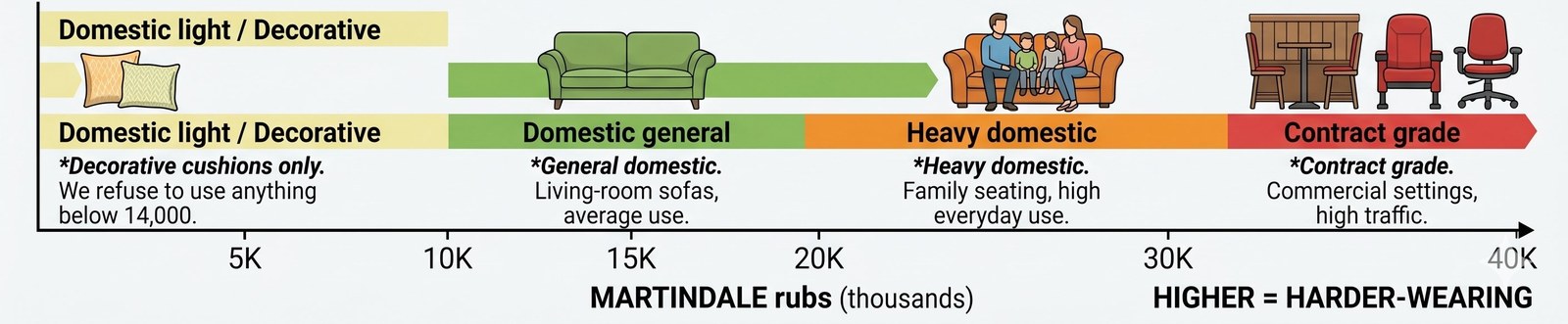
We refuse to use anything below 14,000 on a domestic seat, however much the customer loves the colour. Tell them the rating, let them see the band, let them upgrade their own choice. Customers who insist on under-rated fabric are customers who’ll be back in two years complaining — protect them from themselves.
Most British trade suppliers quote Martindale only. If you see Wyzenbeek (or “double rubs”) on a label, the fabric is American — roughly halve the Wyzenbeek number to compare it with Martindale.
If a customer insists on a fabric we don’t think will last, we either decline the work or note the rating in the written quote and have them initial it. Either way it’s in writing. We’ve never been sued; we don’t intend to start.
Pattern repeat and yardage
Plain fabrics need only enough yardage to cover the chair. Patterned fabrics need that plus the yardage lost to matching the pattern across panel boundaries — and the bigger the repeat, the more fabric you need. A 60 cm vertical repeat can add 50% to the fabric required for a wing-back compared with a plain.
The maths is easier than it sounds. For each major panel — seat, inside back, inside arms, outside back — you need a piece long enough to start the next panel on the same point in the pattern. For a 60 cm repeat and a panel 70 cm long, you don’t need 70 cm of fabric, you need 120 cm (two full repeats), because you can’t start the next panel halfway up a flower. Always tell the customer the yardage cost before they fall in love with a 70 cm repeat: the same chair in plain fabric might be 5 metres; in a large repeat, 7 or 8. Our free fabric calculator will work the yardage out for you in metres or yards, with an allowance for the repeat.
Rough domestic yardages in plain fabric: dining-chair drop-in seat (US: slip seat) 0.5 m; tub chair 4 m; wing-back 6 m; two-seater sofa 10 m; three-seater sofa 14 m; Chesterfield sofa 18 m. Add 30–50% for any patterned fabric.
The single most expensive mistake I’ve ever made was a Chesterfield re-cover in a hand-printed William Morris fabric with an 80 cm repeat. I quoted 18 metres without checking the repeat; the actual yardage was 26 metres. The fabric cost more than the labour by nearly £500, and I absorbed it because I’d quoted in writing. Since 2024 I’ve used a one-page yardage worksheet on every patterned-fabric quote — it calculates yardage panel by panel, with a column for the repeat and a column for the panel size. Don’t quote large-pattern jobs without one.
Silk is the most prestigious upholstery fabric and the most fragile under sunlight. UV light breaks the long protein chains in silk faster than in any other natural fibre — a silk cushion in a south-facing window can lose 30% of its tensile strength in a single year, and fade noticeably in months. This is why great houses have always kept their silk rooms north-facing or shuttered; the eighteenth-century habit of dust covers wasn’t aesthetic, it was a preservation strategy for the silk underneath. Tell silk customers this, and tell them to think hard about which window the chair will sit near.
Buying trade, not retail
There’s a roughly 30% price difference between buying fabric from a trade supplier — which requires a trade account, usually evidenced by a VAT number or AMUSF membership — and buying the same fabric from the retail end of the same supplier. Beginners don’t know about this and pay full retail; pros know, and pay trade.
The trade suppliers we use most are Edmund Bell (everyday wool blends), Romo and Black Edition (mid-to-high-end domestic), Sanderson and Morris & Co (the heritage prints), Linwood (mid-range, good stock-keeping), Designers Guild (high-end), and Warwick (good-value plain weaves). All require trade-account approval; most will accept an AMUSF membership number plus a workshop-visit photograph, and the discount lifts you to the same rate the interior designers pay. Applied across a year, that difference can add up to a comfortable holiday.
Another reason to belong. The trade-account approval process at most major suppliers takes a week or two; with an AMUSF number it’s often instant.
Quoting yardage without checking the pattern repeat. The single most expensive mistake in the trade. Always check.
Letting the customer choose under shop lighting. Take samples to the customer’s home and look at them in the room they’ll live in — colour temperature changes everything.
Pile direction errors. Velvets and other piled fabrics have a direction that affects the light. Cut every panel the same way or the chair looks two-toned in raking light; mark each one with an arrow as you cut.
Buying retail, not trade. Get the trade account first, even for a single job — the savings start immediately.
Not asking about pets. A wool blend that’s perfect for a childless couple is a magnet for cat fur. Customers with pets need higher synthetic content; ask up front.
Measuring & cutting kit
- Upholstery / fabric shears (paid link)
- Cloth tape measure (metric & imperial) (paid link)
- Tailor’s chalk for marking panels (paid link)
Rather hand this one to a professional? Find a good upholsterer near you →