Replacing a car carpet set is a patterning job before it is a fitting job: strip the interior, lift the worn original out whole, and cut the new one to its shape. This Jensen S-V8 came in with a tired red carpet throughout and went back out in navy. There is no moulded carpet set on a shelf for a car like this — fewer than fifty S-V8s were ever finished — so every panel was cut from flat automotive carpet to the shape the factory made, glued down with high-temperature contact adhesive, and the trims and seats put back over the top.
| Piece | Jensen S-V8 roadster — full interior carpet set |
| Category | Vehicles & Campervans |
| Bench hours | 10 |
| Fabric | Navy automotive carpet |
| Materials | High-temperature contact adhesive; the original carpet retained and used as the cutting patterns |
Stripped out — down to the bare floor
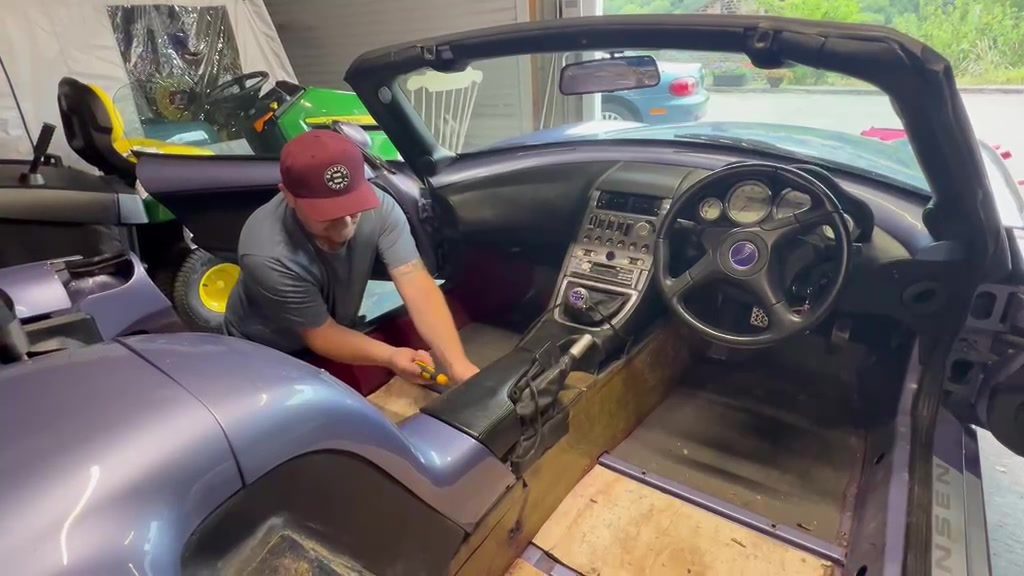
This is where a carpet job actually starts, and it is more dismantling than upholstery. Seats out, seat belts unbolted, sills and kick panels off, centre console away, gear lever gaiter and handbrake boot released. Every fixing you take out is one you have to find again on the way back, and every trim that laps over a carpet edge is telling you the order things have to go in. Strip it in sequence and photograph as you go, because nobody remembers which of four similar screws came out of which hole three days later.
The old red carpet — the only pattern that exists
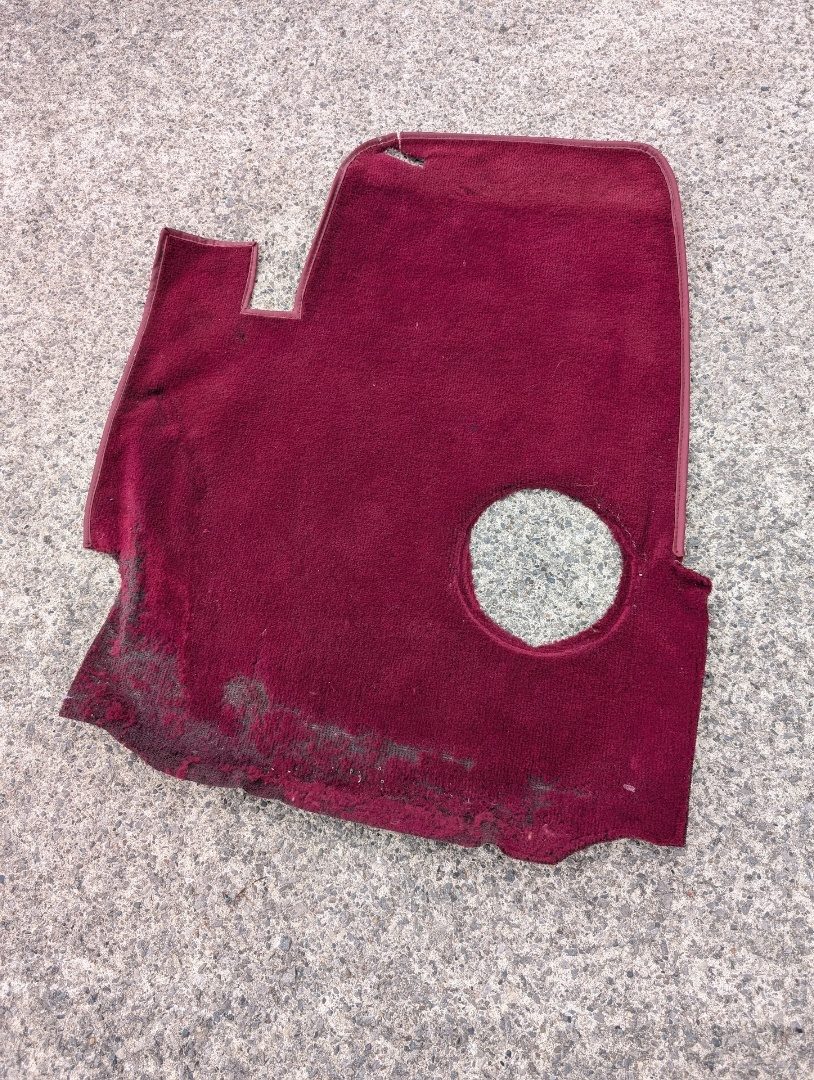
This is the whole job in one photograph. That worn red panel is not rubbish, it is the pattern, and it is the only one that will ever exist for this car. Look at what it already carries: the finished bound edge along the top, the round aperture cut for the gear lever, the stepped notch where it clears the bulkhead, and the scalloped bottom edge shaped to sit under the sill trim. Every one of those was worked out at the factory in 2002 and none of it has to be worked out again — it just has to be copied accurately. So it comes out as intact as it can be persuaded to come, gets brushed off, and goes on the bench face up. Before anything else it is marked: which panel, which way up, which way the pile runs, and where the centreline falls. Then it is laid on the flat navy carpet and cut round with a working allowance on the edges that will finish under a trim. The dirt and wear you can see along the bottom of this piece is exactly why it was being replaced — and exactly why it needed photographing before it went in the bin.
Back together in the workshop
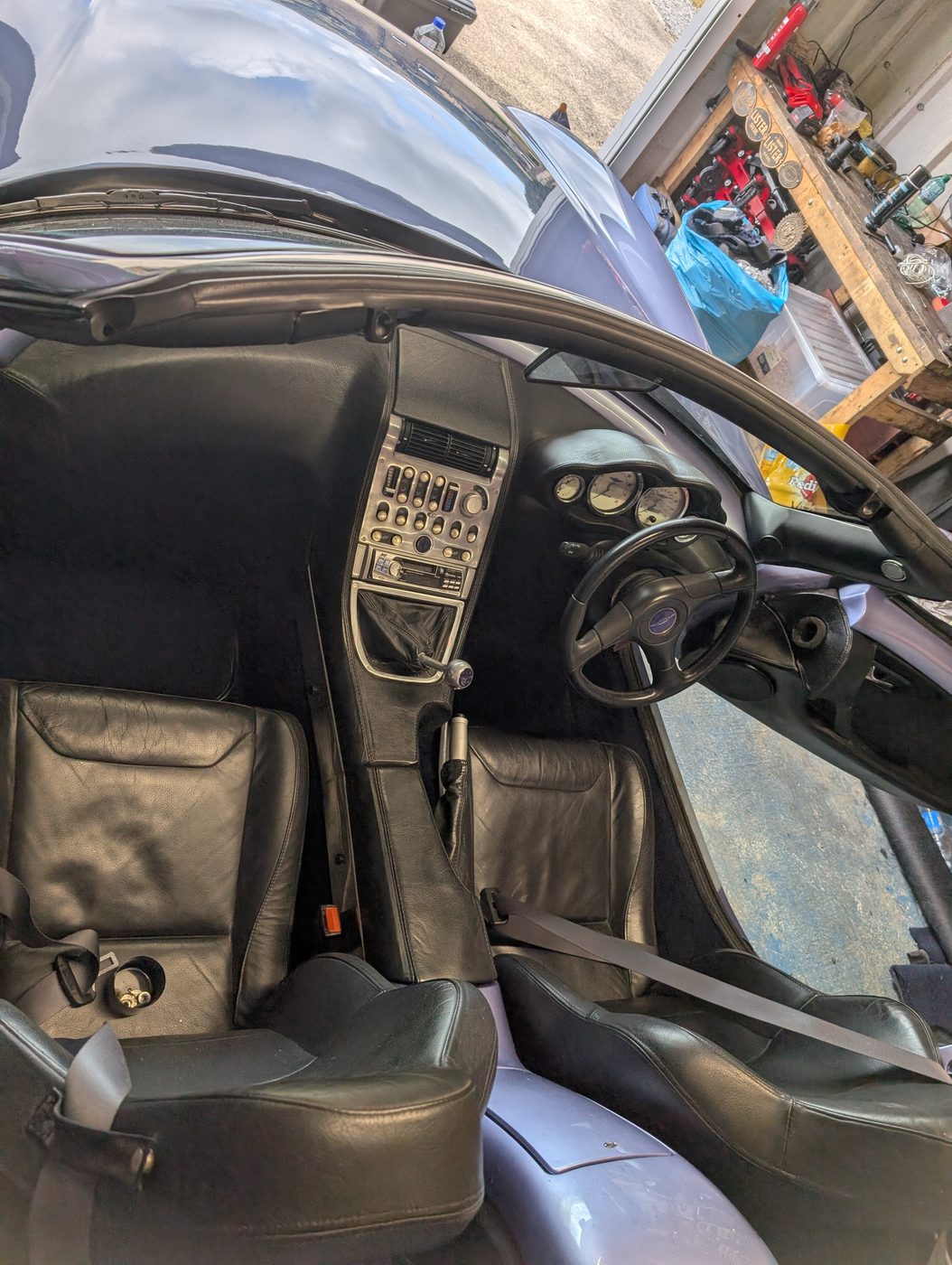
With the patterns laid on flat automotive carpet and cut round with a working allowance, the new panels went in. The transmission tunnel is where these jobs are won or lost — it is a compound curve, falling away in two directions at once, and flat carpet will not sit on it without the relief cuts the old panel shows you. Everything was dry-fitted first: laid in, pressed into the tunnel, checked against the console mountings and the gear lever aperture, and only then glued. High-temperature contact adhesive gives you one attempt, so the dry fit is the job rather than a formality.
On the field, nine days later
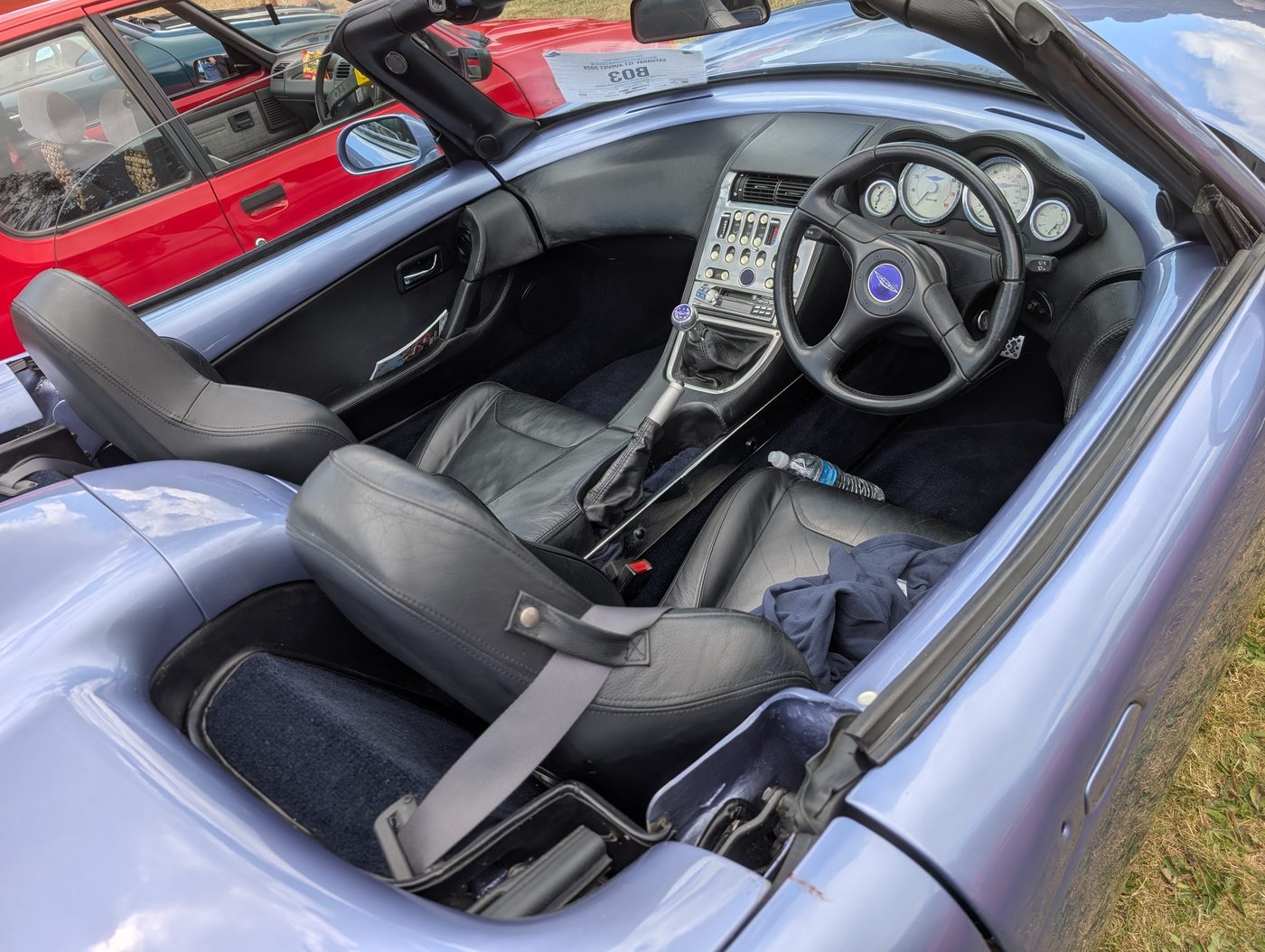
Nine days after the workshop photograph the car was on a show field with the roof folded — which is the real test of a carpet job, because a convertible has nowhere to hide. Every trimmed edge and every shade difference in the pile is out in daylight for anybody who cares to lean over the door, and at a show plenty of people do exactly that.
Navy against black leather and alloy
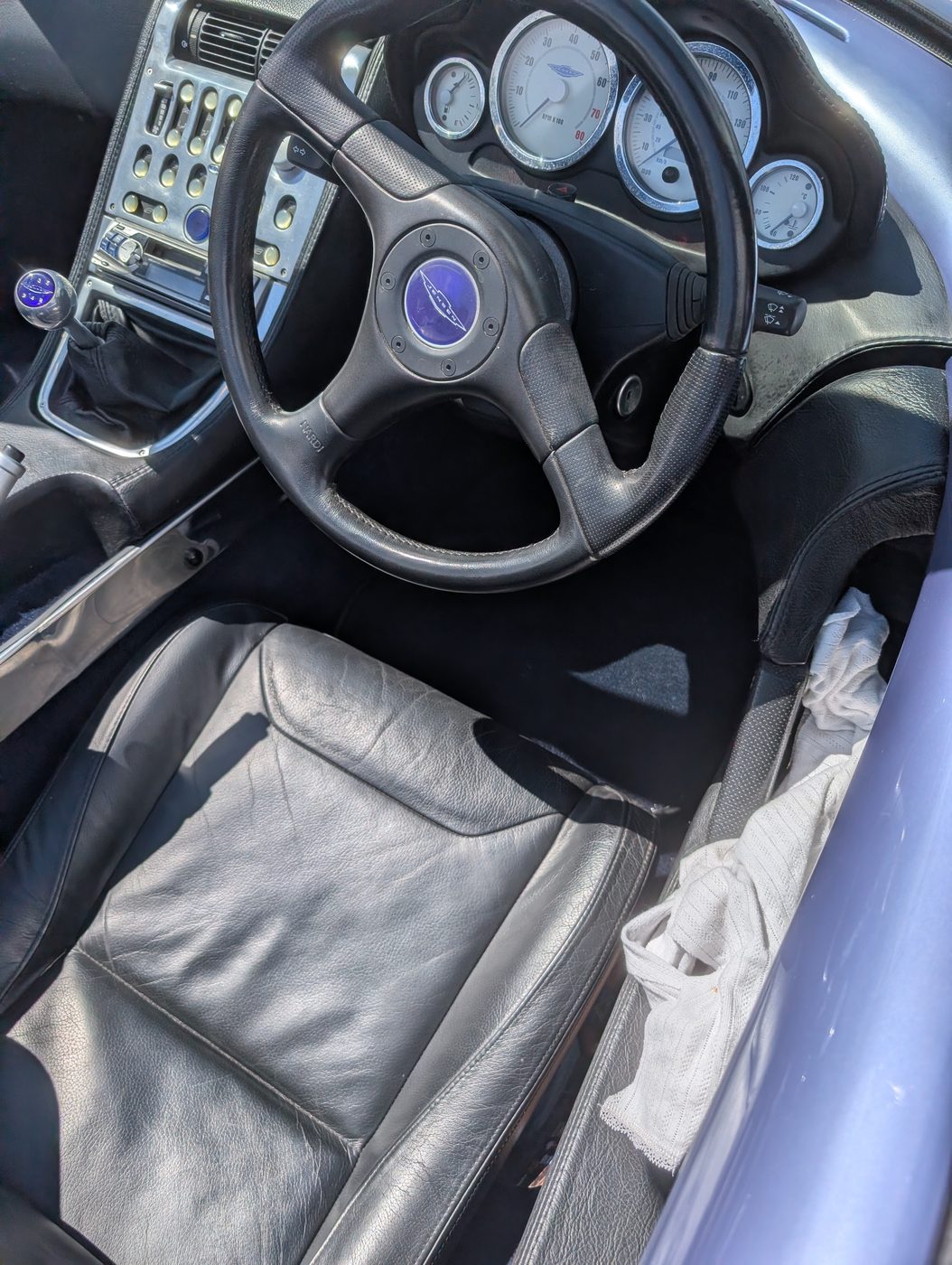
Colour choice matters as much as workmanship. The original red had gone flat and pink with age and fought with the lilac-blue paintwork; navy sits under the black leather and the brushed alloy switch panel without arguing with either, and it answers the exterior colour instead of clashing with it. It is a quiet decision that makes a cabin look deliberate, and it costs nothing extra at the point of ordering.
One continuous run
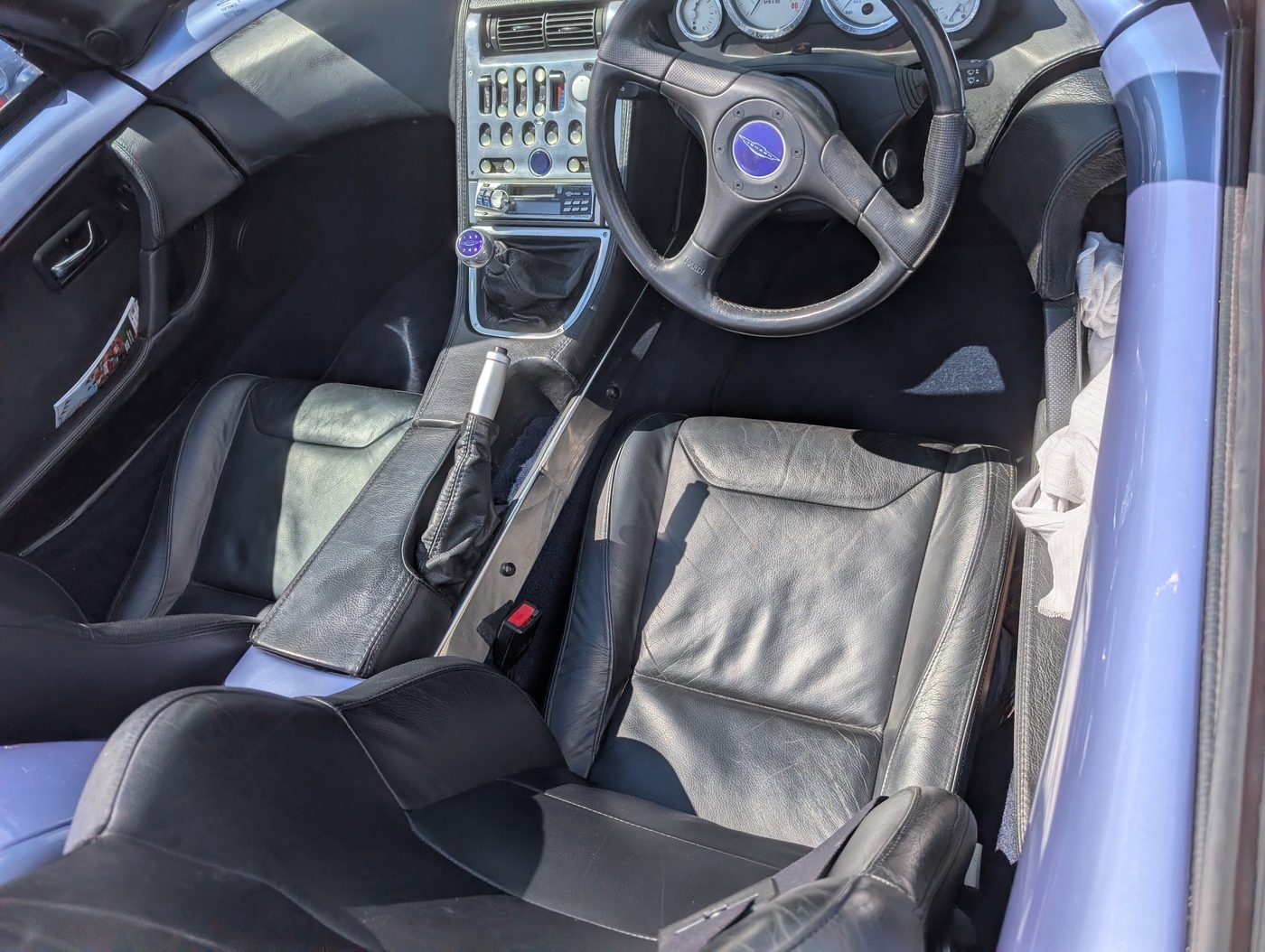
This is the view that shows whether the patterning was honest. The carpet runs from footwell to tunnel to console without a break in tone or a rippled edge, the console and gear gaiter sit down on it properly, and the seat rails clear it as they were always meant to. Nothing here is a new shape: it is what the factory cut, copied off the originals and made again in a better colour. It also answers the question about pile direction — every panel was laid on the roll the same way up before cutting, because carpet cut with the nap running two ways reads as two different shades of navy the moment sunlight gets into the car.
The seat, the belt anchor and the carpet edge
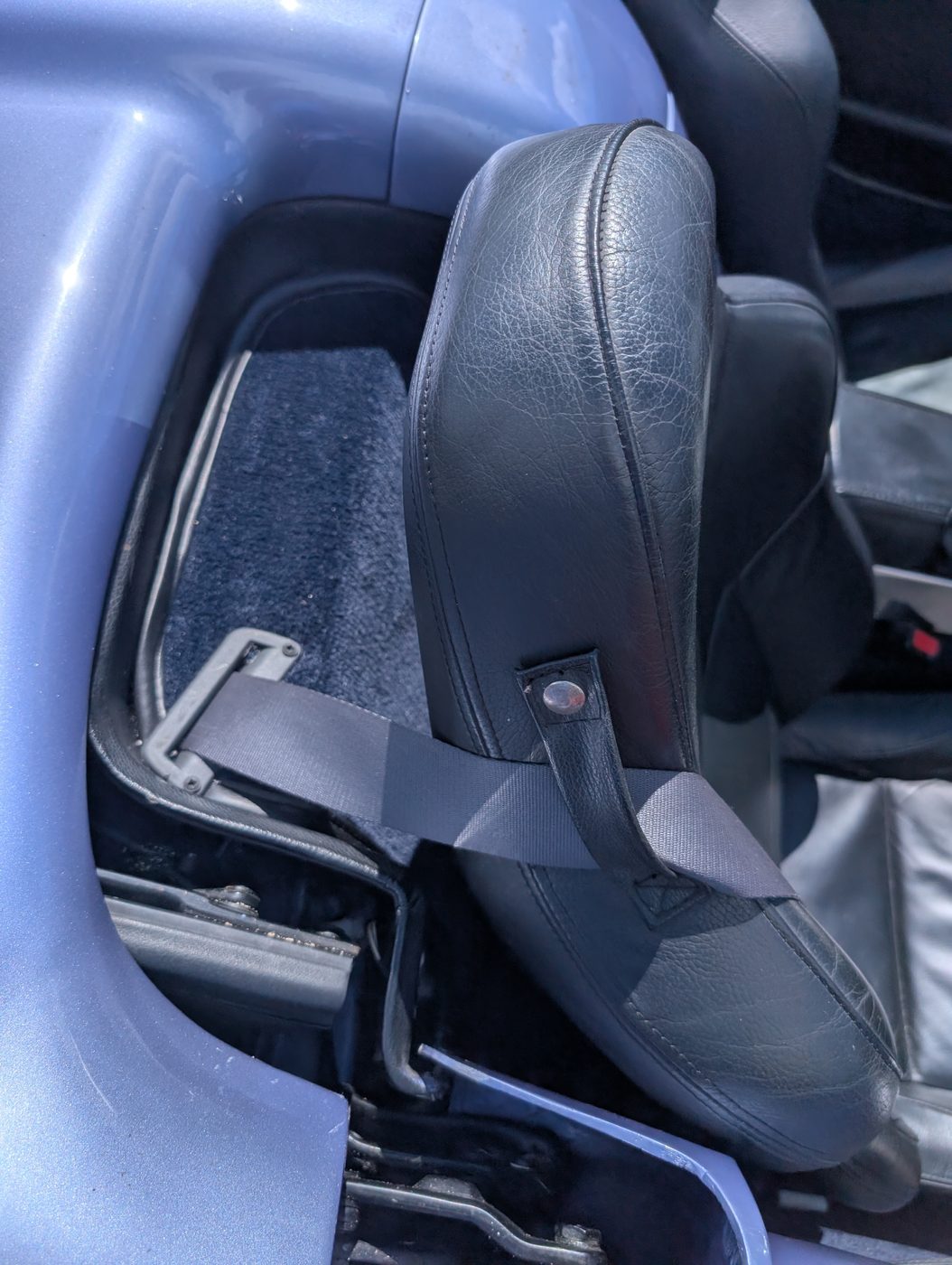
Refitting is not simply the reverse of stripping. Seat belt anchor bolts are a safety-critical fixing and go back to the manufacturer's torque, with the carpet trimmed clear of the mounting face rather than trapped under it — carpet caught under a load-bearing washer compresses over time and lets the fixing slacken. The seat runners bolt to their original captive points, the carpet is relieved around them, and the sill trim goes back last to cover the cut edge.
The methods behind this job
Every technique used here is set out in full in the book:
- Stripping the Old Work
- Materials — A Field Guide
- Trimming & Finishing
- Work out the material for your own job
Questions about this job
How do you pattern a car carpet set if you cannot buy a moulded one?
You use the old carpet. Strip the interior right back, lift the original out in as few pieces as possible, and it becomes your pattern set — it already carries every relief cut, every seat-rail aperture and every trimmed edge the factory worked out. Before anything moves, mark each piece: which panel it is, which way up, which way the pile runs, and where the centreline falls. Then lay each old panel on the new carpet and cut round it with a working allowance at the edges that will be hidden by trim. On rare or low-volume cars this is the only method available, because nobody makes a moulded set for a car built in tens rather than tens of thousands.
What glue should you use to stick carpet into a car?
High-temperature contact adhesive, the vehicle-grade sort rated to around 120°C. A car standing in summer sun reaches temperatures that soften ordinary contact adhesive, and once it softens the carpet creeps, lifts at the edges and bubbles across the tunnel. Coat both faces, let them flash off until touch-dry, then bond — it grabs on contact, so position everything with a dry fit first. Where a trim, sill or kick panel laps over a carpet edge, let it do its share of the holding rather than asking the adhesive to carry a raw edge on its own.
Does the pile direction of car carpet matter?
Yes, and it is the mistake that shows up in daylight rather than in the workshop. Automotive carpet has a nap, so light reflects differently depending on which way the pile lies. Two panels cut from the same roll but laid opposite ways will read as two different shades of navy, black or grey once the sun gets into the cabin, and no amount of good fitting will disguise it. Mark the pile direction on every pattern piece as it comes out, and lay every new piece on the roll the same way up before cutting.
Do the seats have to come out to fit a new car carpet?
For a proper job, yes — along with the seat belts, sills, kick panels, centre console and any trim that laps a carpet edge. Carpet cut around fixed seats has to be slit to get it in, and those slits are visible for the rest of the car's life. Taking the interior out also lets you see and clean the floor, which is where the useful discoveries are made: damp underfelt, surface rust, a blocked drain channel. Refitting is where the care is needed rather than the speed — seat belt anchors and seat runners are safety-critical fixings and go back to the correct torque, with the carpet trimmed clear of the mounting faces rather than trapped underneath them.
How long does it take to fit a new car carpet set?
This one was ten hours from start to finish — stripping the interior, lifting and marking the old carpet, cutting the new panels, gluing them in and refitting everything over the top. That is a fair figure for a small two-seater with a simple floor. Expect more on a four-seat car, on anything with a complicated console or rear seat arrangement, and on any car where the old carpet has to be recovered in pieces rather than lifted out whole. The fitting itself is the quick part; the stripping and the patterning are where the hours go, and rushing either is what produces the jobs you can spot from the doorway.
What is a Jensen S-V8?
A two-seat British roadster, the last production car to carry the Jensen name. It was launched at the 1998 motor show and eventually built at Speke on Merseyside from August 2001, using a 4.6-litre Ford V8 in a steel monocoque under pressed aluminium panels. Only about twenty cars left the factory before Jensen went into administration in July 2002; the part-built cars were sold on and finished afterwards, giving a total of fewer than fifty. That rarity is exactly why the original carpet had to come out in one piece — there is no catalogue to order a replacement set from.