This is the other side of the trade from restoration: a wing chair built brand new, from the bare frame up. No stripping, no old cover to copy — instead, a modern build with an elastic-webbed back and an elastic-webbed seat, upholstered in a bold red tartan check. And a check like this is the sternest examiner in upholstery, because every panel answers to every other: the lines have to run true horizontally and vertically, through the wings, the arms, the inside back, the seat and the facings, so that from any angle the pattern reads as one continuous cloth. Here is the build, in the order the work happens.
| Piece | Modern wing chair (new build) |
| Category | Furniture |
| Fabric | Red tartan check, pattern-matched across every panel |
| Materials | New-build frame, elastic webbing to back and seat |
Wings first
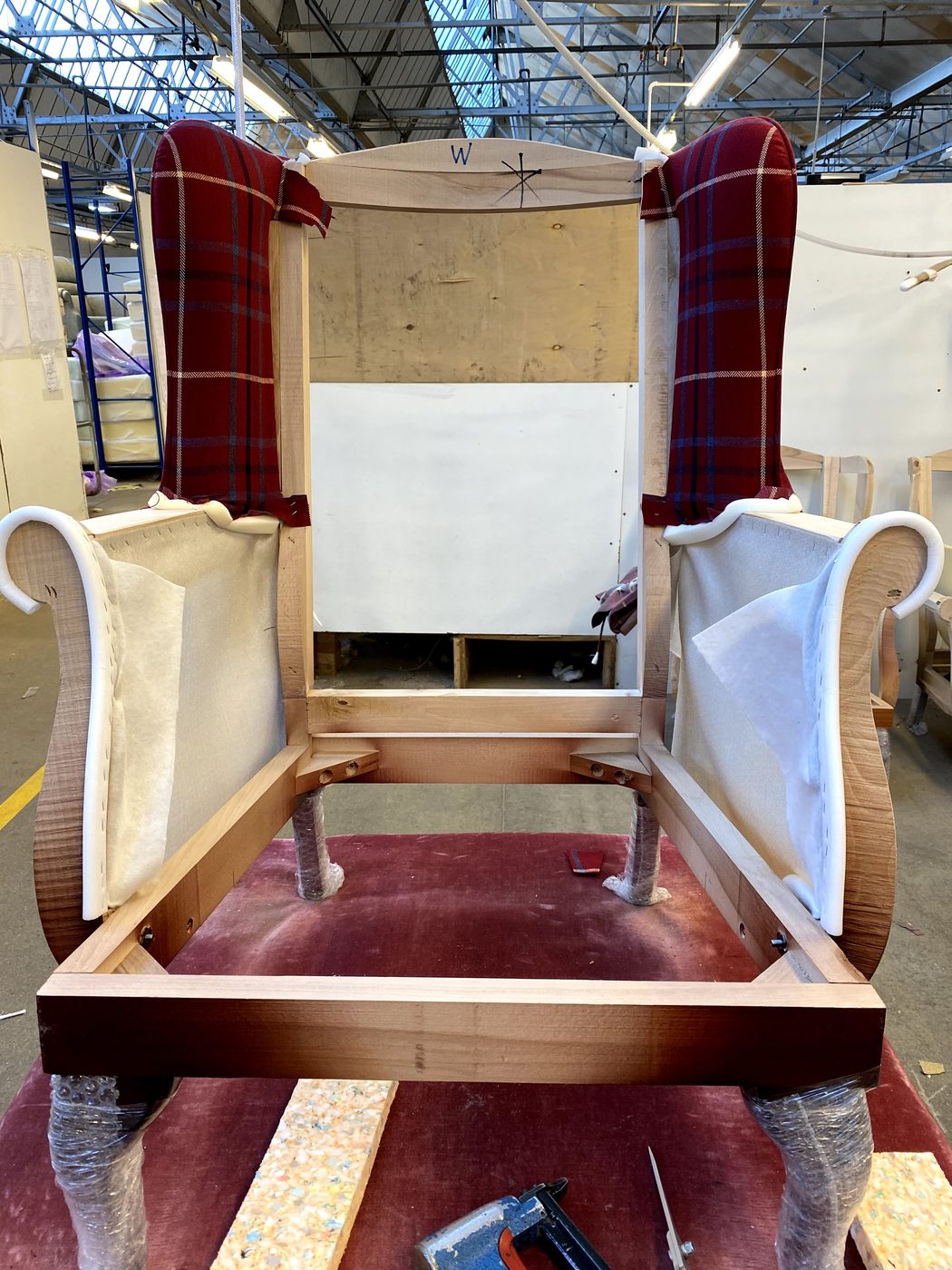
On a wing chair the covering starts with the wings, and on a new build that means the frame is prepped and the foundations are on before the first face fabric goes anywhere near it. The wings are covered first with the check carefully centred, because these two panels set the pattern for everything that follows — every panel after this has to agree with them. At this stage the arms are still sitting in their pale under-wrap and the inside back is bare: the chair is a promise, not yet a picture.
The arms
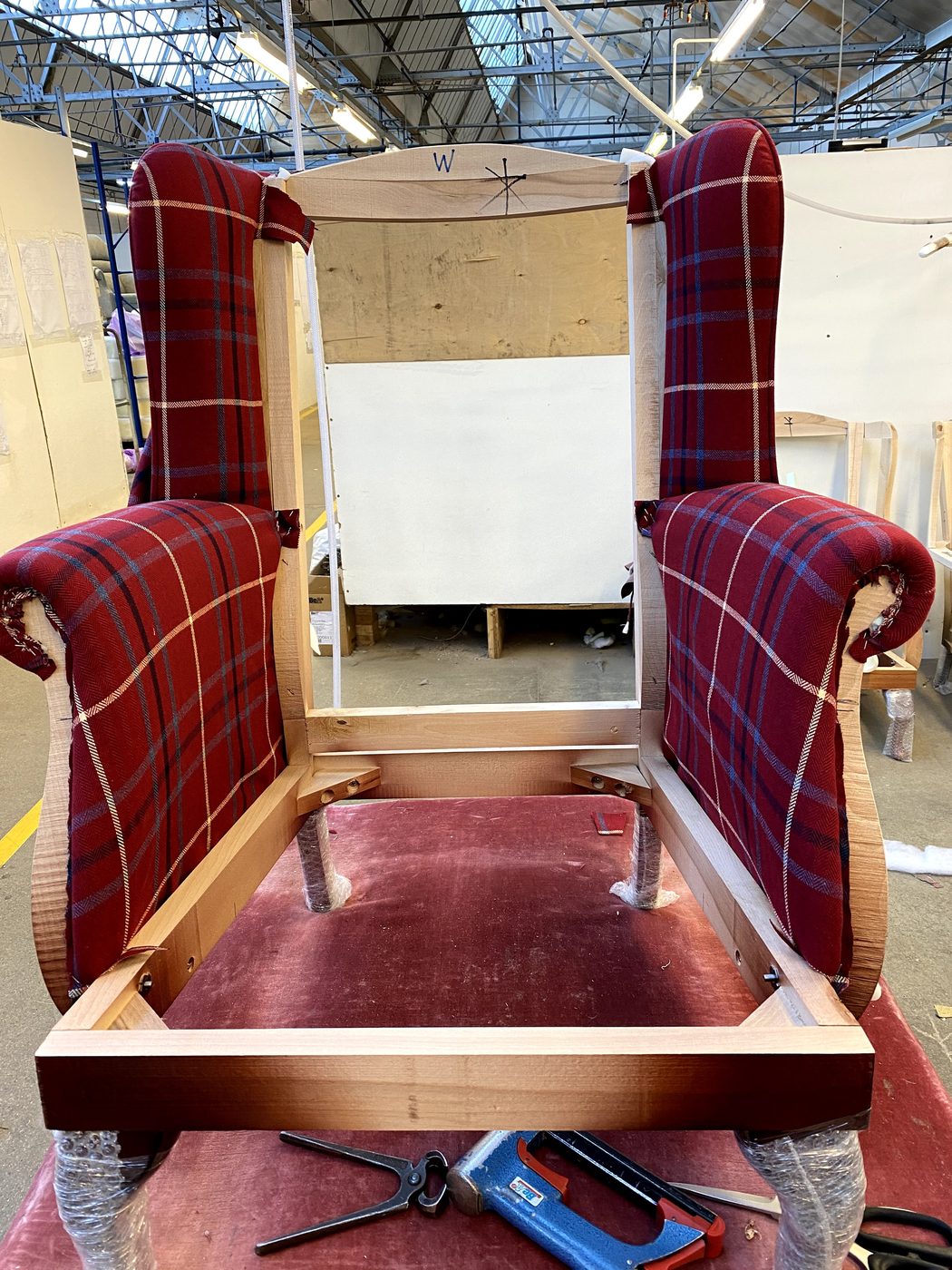
The arms follow the wings, and this is where the pattern-matching discipline starts to earn its keep. The check on each arm has to mirror its partner exactly, and the lines have to carry through where arm meets wing, including around the curve of the scroll — the hardest place to keep a straight-lined pattern honest, because the fabric is being asked to bend in two directions while its lines stay straight. Worked in evenly from the centre out, the check holds its grid.
The inside back, on elastic webbing
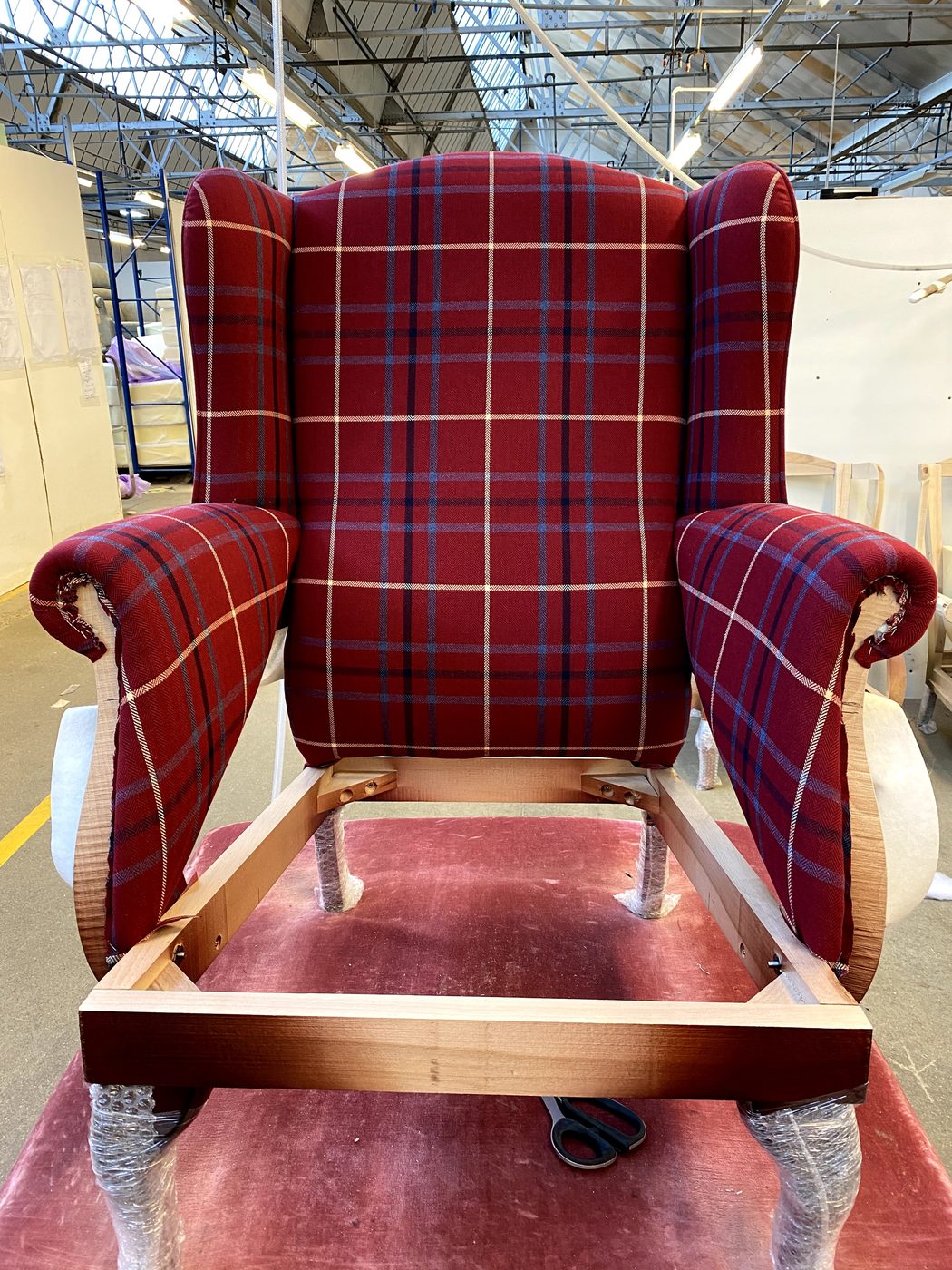
Behind the inside back of this chair is elastic webbing — the modern suspension, rubber-cored bands tensioned across the frame in place of traditional springs. It gives a consistent, quiet, resilient support that suits a modern build. Over it, the inside back panel goes on with the check centred on the chair's centre line, verticals running dead plumb, horizontals lining through with the wings and arms either side. This is the biggest single panel on the chair and the one your eye lands on first, so it has to be perfect.
The seat, on elastic webbing
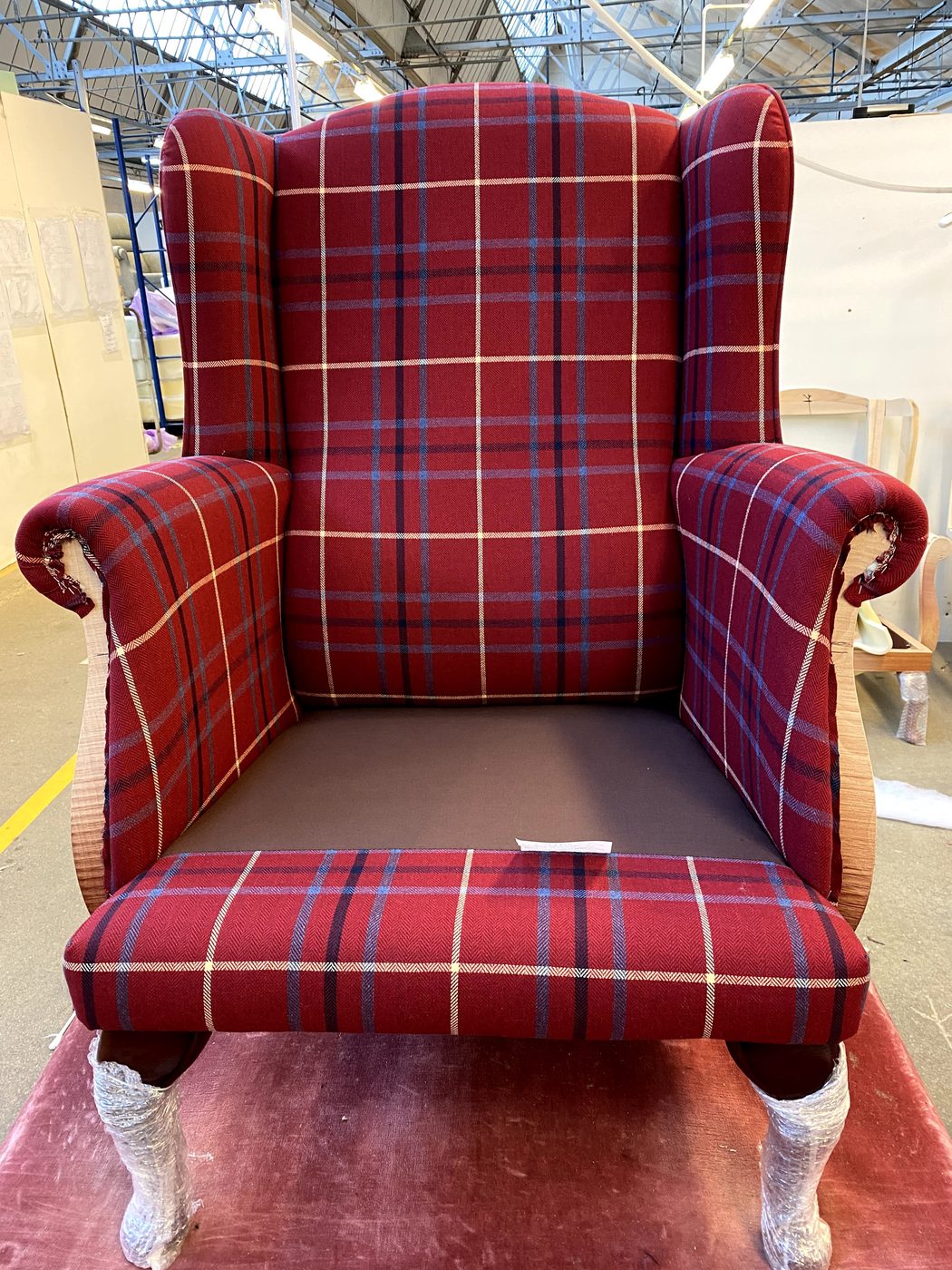
The seat platform is elastic-webbed the same way as the back, then covered with the check aligned to the inside back — so the lines flow down the back and continue along the seat without a stutter. Front to back, side to side, the grid keeps its promise. Elastic webbing under a seat gives a firm, even platform with a little life in it, and unlike coil springs it never needs re-tying.
The facings
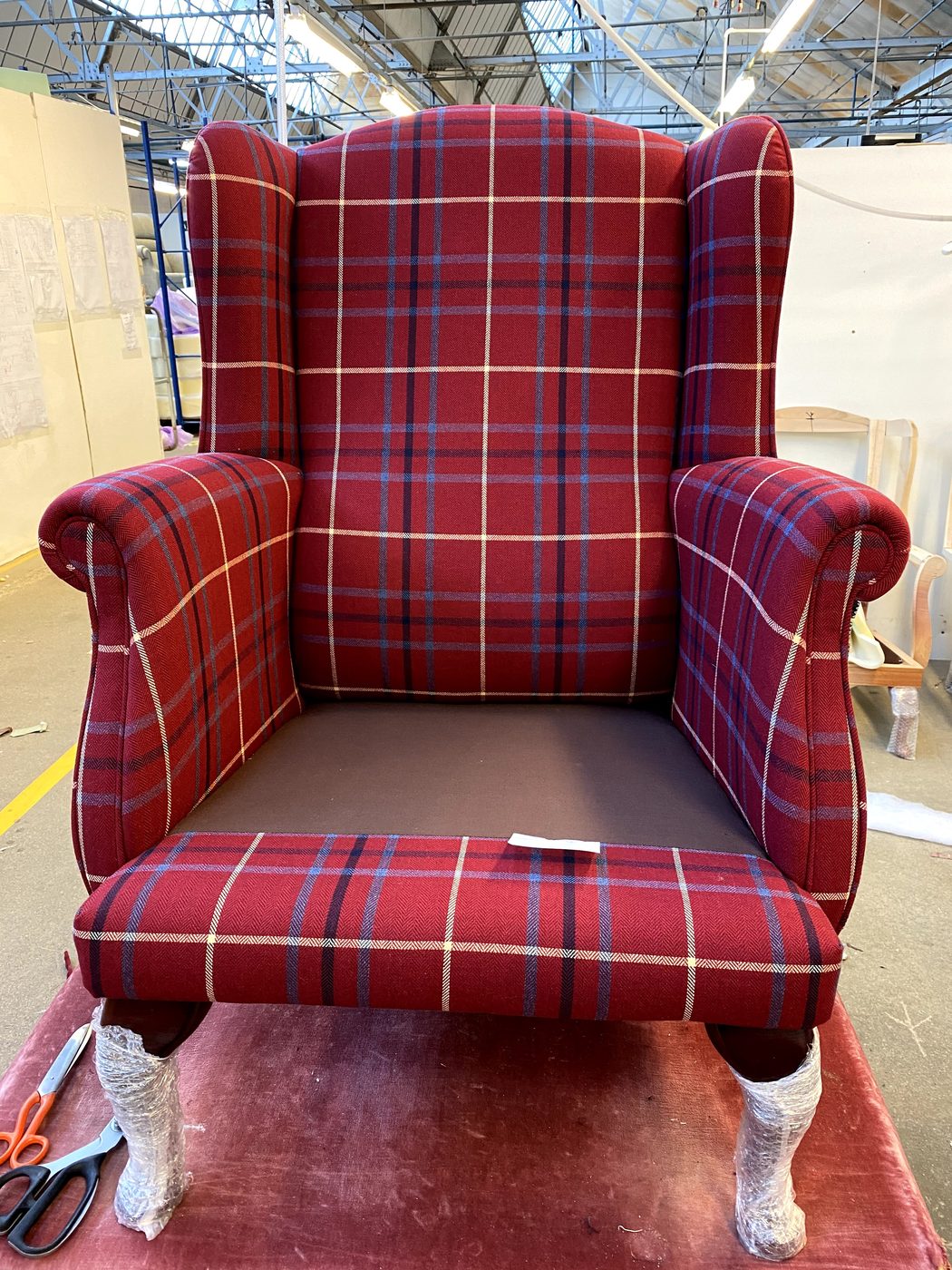
The facings — the shaped panels on the front of each arm — are small, but they sit right at eye level on the front of the chair, and on a checked fabric they are unforgiving: each one has to be matched to the arm it belongs to and mirror its partner across the chair. Cut carefully, fitted cleanly, they finish the front of the arms and frame the seat.
The outside arms
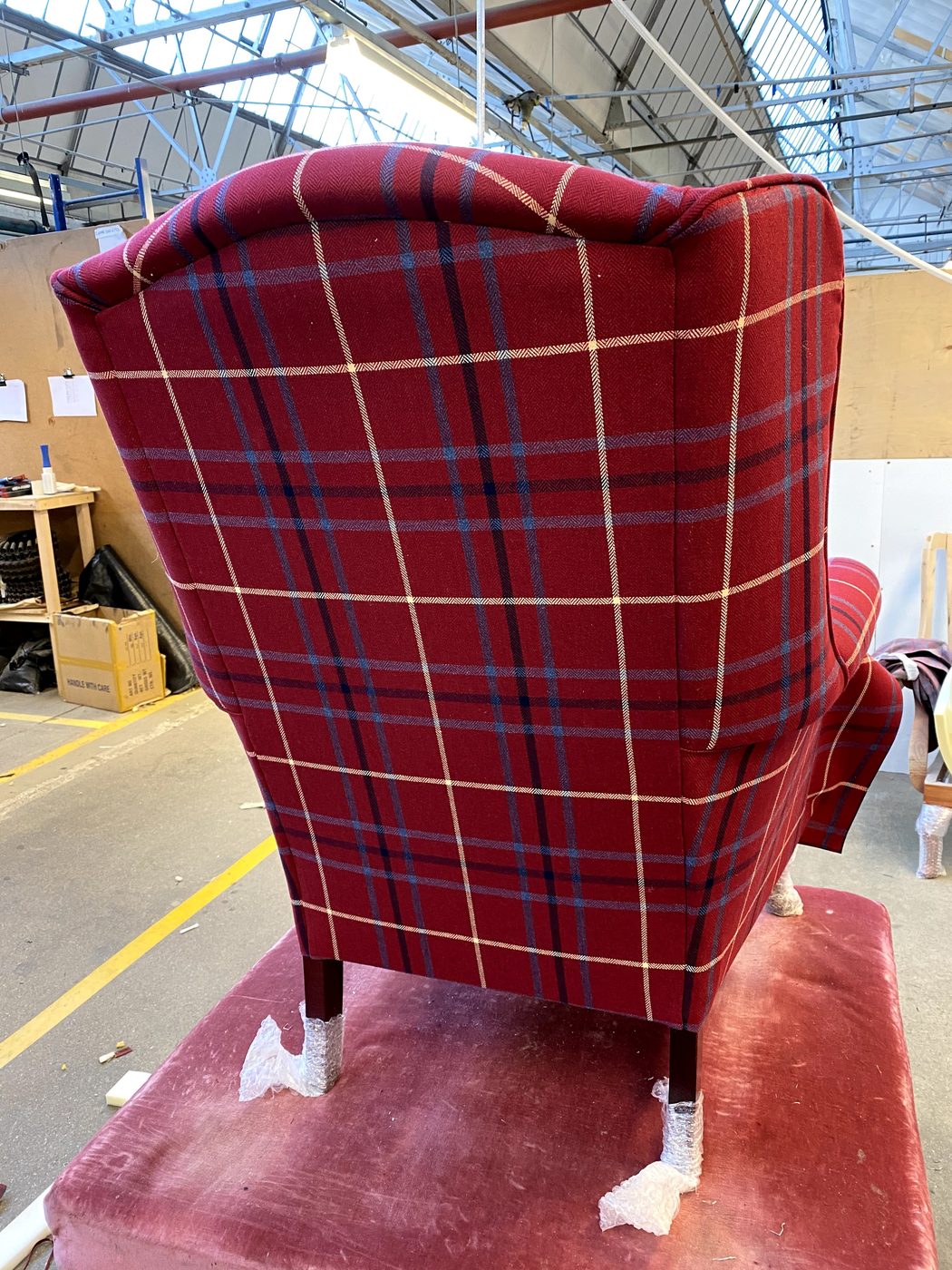
With the inside of the chair complete, the outsides close it in. The outside arms go on with the pattern kept honest around the sides — the check on the outside faces lining through with the panels above them, so the chair reads as one continuous cloth as you walk around it rather than a collection of separate pieces.
The outside back
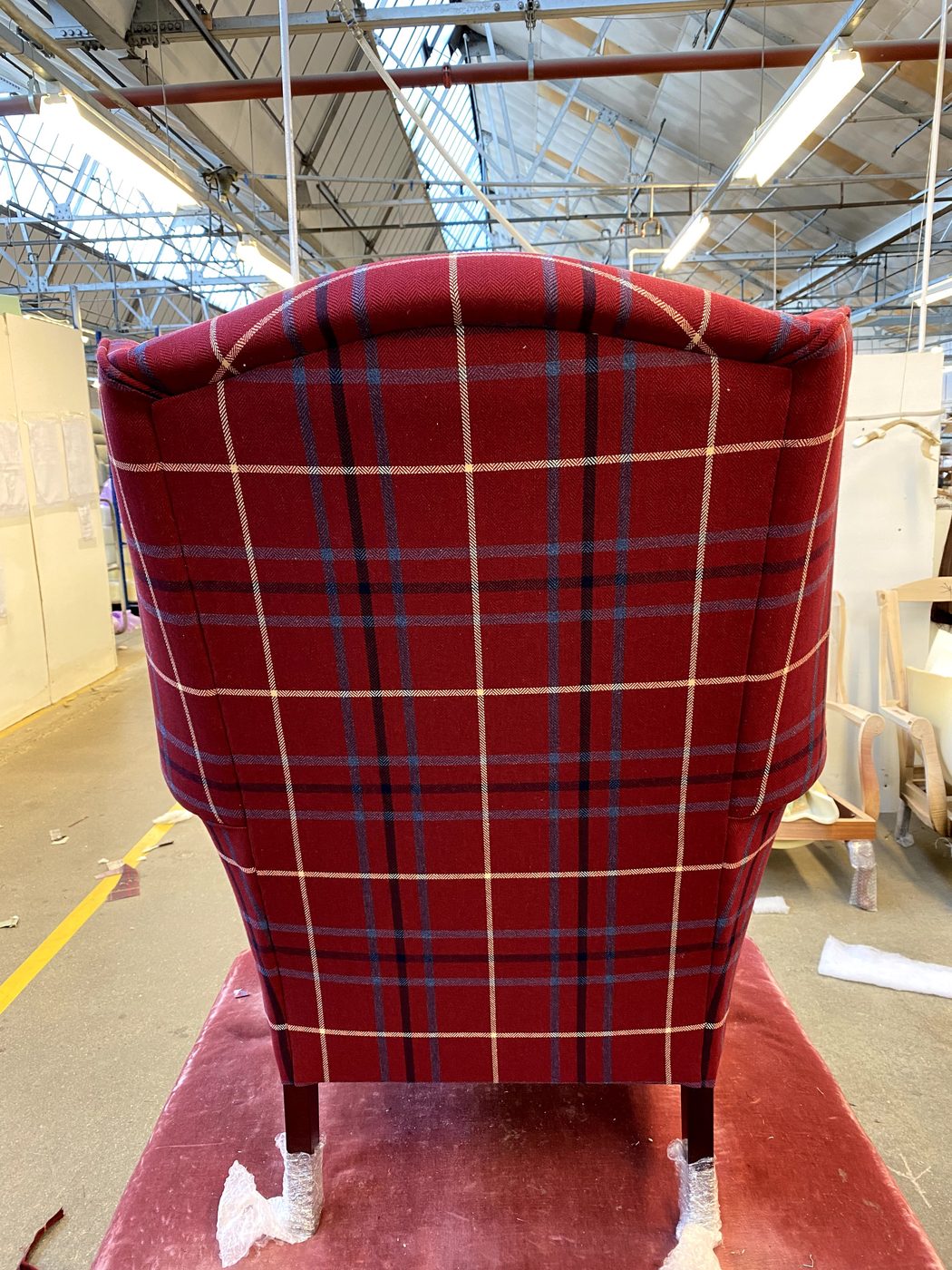
The outside back is the final large panel, closed in with a clean, straight finish along every edge and its check centred to agree with the inside back on the other side of the frame. The back of a chair is where corners get cut in lesser work — but it is the first thing you see when the chair sits away from a wall, so it gets the same discipline as the front.
The finished chair
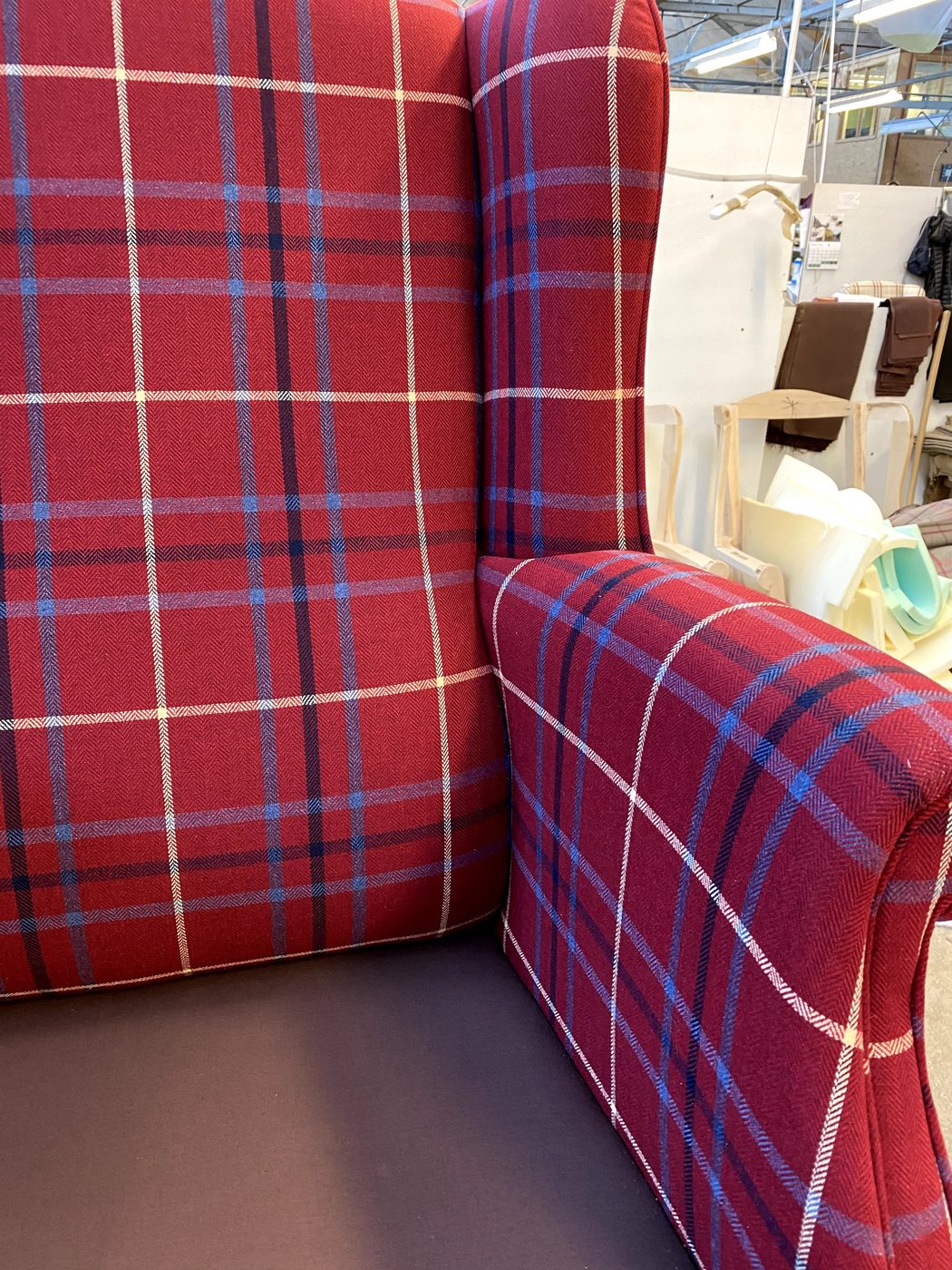
And there it stands: a wing chair that did not exist a short while ago, built new and dressed in a bold red tartan with every line running true — up the back, along the seat, through the wings and arms and facings, front and back in agreement. A plain fabric hides a multitude; a check like this hides nothing, which is exactly why getting it right is so satisfying.
The methods behind this job
Every technique used here is set out in full in the book:
Questions about this job
What is elastic webbing, and is it as good as traditional springs?
Elastic webbing is a woven band with rubber cores, tensioned in rows across the frame to support the back or seat. It is the standard modern suspension: consistent, silent, and it never needs re-tying the way a sprung and lashed seat eventually does. Traditional coil springs, done well, give a deeper and longer-lived ride and are the right choice for restoring a traditional chair — but for a modern new build like this one, elastic webbing is the appropriate, honest construction, and it performs very well.
How do you pattern-match a check on a wing chair?
By planning every panel before the first cut. The check is centred on the chair's centre line, and each panel is cut so its lines carry through to its neighbours — wings agreeing with arms, inside back running plumb, the seat flowing on from the back, facings mirroring each other, and the outsides keeping the grid honest as you walk around the chair. It takes more fabric and much more time at the cutting table than a plain cloth, because every piece has one correct position and nothing can be shuffled to save material.
Is a new-build chair upholstered differently from a reupholstered one?
The covering order is the same — wings, arms, inside back, seat, facings, then the outside panels — but a new build starts from a bare frame with no old cover to strip and no existing foundations to assess. Everything from the suspension up is built fresh, which means the upholsterer chooses the construction: here, elastic webbing to the back and seat with modern fillings, rather than the springs and stitched edges of a traditional restoration.
How much extra fabric does a checked or patterned fabric need?
More than a plain cloth, always — because every panel must be cut in its one correct position on the pattern, you cannot nest the pieces tightly to save material. As a working rule, allow roughly an extra half metre to a full metre on a chair this size, depending on the size of the pattern repeat: the bigger the repeat, the more waste between usable positions. Our fabric calculator lets you factor a pattern repeat into your own estimate.