Modern springing is the cheap, fast, factory cousin of the hand-tied work in the previous chapter.
Where a coil-sprung seat takes a working day, a zigzag-sprung seat takes fifteen minutes; where a hand-tied seat stays comfortable for sixty years, a zigzag-sprung seat is good for about ten. Almost every high-street sofa made since 1960 uses zigzag — or “sinuous” — springs, and so do most modern reupholstered pieces, because the customer is rarely willing to pay for the labour of coil-spring work.
This is a much shorter chapter than the last. Zigzag springing is a simple technique with few decisions: choose the spring gauge, cut the springs to length, clip them to the rails, cross-tie them with twine. The chair is sprung; the work is done. Whether you should use zigzag rather than coil is the more interesting question, and this chapter's first concern.
Customers don't usually know the difference — so tell them. Show them the cutaway diagrams from Chapter 2 if it helps. Most customers, once they understand the choice and what it costs, choose well. The few who pick zigzag for an Edwardian piece anyway are usually choosing against advice they took in.
We use zigzag springs about half the time. On a modern piece, for a customer who's clear they want a ten-year sofa rather than a heritage piece, zigzag is right. On older pieces — anything Edwardian or earlier — zigzag is wrong, and we won't fit it even if asked: the frame was built for coil-spring loading, its dimensions are wrong for zigzag, and the customer is usually buying the chair as much for what it is as for somewhere to sit.
When zigzag is the right answer
Use zigzag on:
- factory-made post-1960 sofas and armchairs that already had zigzag from new;
- modern foam-and-staple pieces being re-covered in their original style;
- pieces where the budget genuinely won't stretch to coil work;
- outdoor seating, where coil springs would corrode;
- any piece with a frame too shallow for coil-spring height.
Don't use zigzag on:
- anything older than the 1950s;
- any piece where the customer wants longevity over comfort;
- any piece with a frame deep enough to take coil springs;
- and never as a substitute for coil work on a piece that originally had coils.
Coil springs need at least 8″ (200 mm) of frame depth between the webbing and the top of the seat rails to fit in their working height. Zigzag springs work in as little as 4″ (100 mm). On a shallow modern frame, zigzag is the only option.
Springs and clips
Zigzag springs (paid link) are sold in coils, by gauge and length. 11-gauge is the lightweight grade for chair backs and small seats; 9-gauge is the standard for chair seats; 8-gauge for sofa seats and any heavily-loaded use. Lower numbers mean thicker wire and a stiffer spring. Length comes by the foot or the metre off a coil — you cut to fit at the bench with bolt cutters or a heavy wire-cutter (paid link).
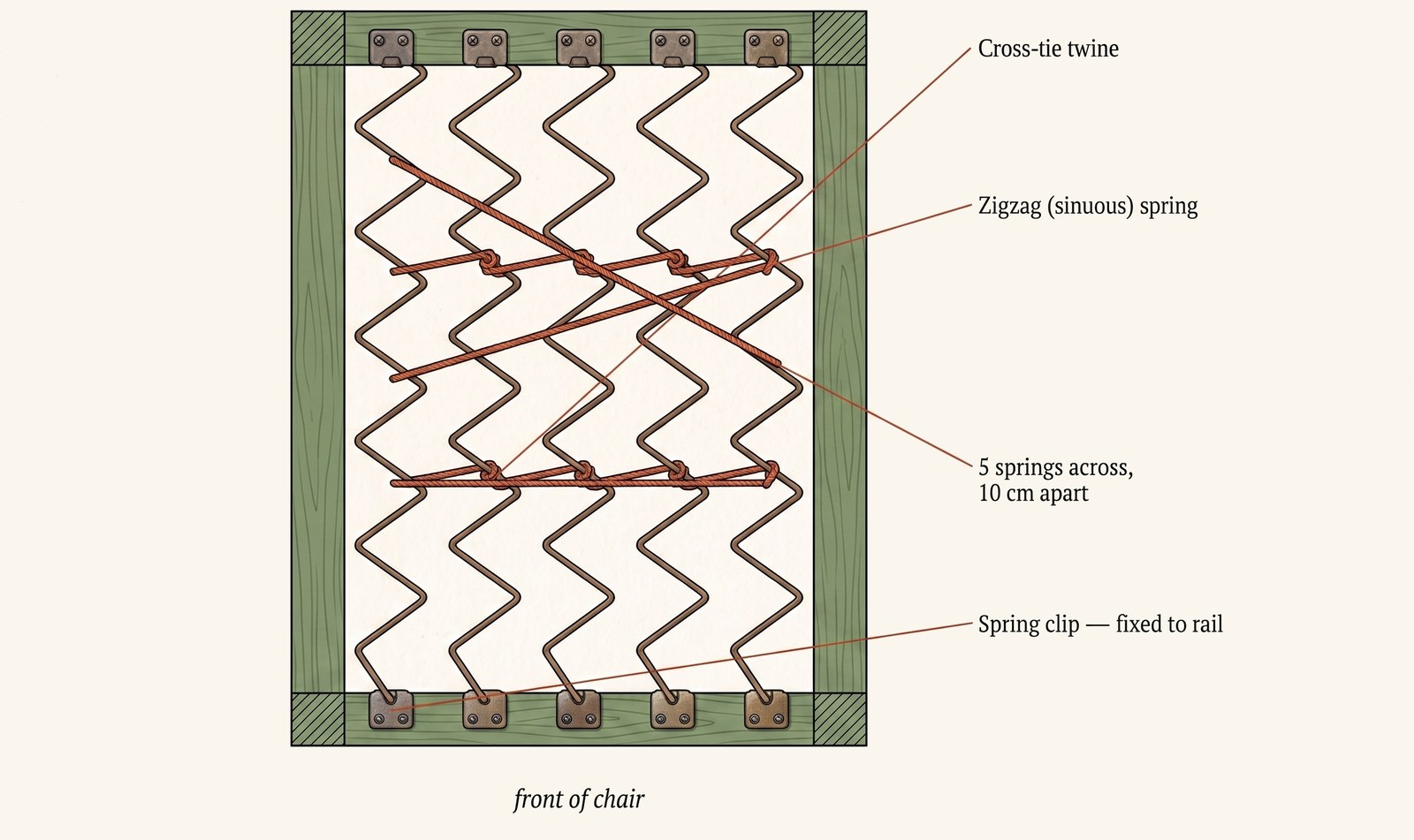
Spring clips (paid link) are stamped-steel U-brackets, sold in boxes of 50 or 100 and sized to match the spring gauge. They have two screw holes — use 25 mm wood screws — and a top edge that crimps over the spring's terminal hook to lock it in place. Genuinely simple hardware. Cross-tie twine — the same waxed mattress twine (paid link) you use for everything else — is laid across the springs at one or two points along their length to stop them swaying side-to-side: two cross-ties on a deep seat, one on a shallow one. The whole job takes less than five minutes.
Standard pairings: dining-chair seat 11-gauge; armchair seat 9-gauge; sofa seat 8 or 9-gauge; chair back 11 or 12-gauge. When in doubt, slightly lighter is better than slightly heavier — an over-sprung seat feels like a board.
How many zigzag springs does a seat need?
Zigzag (no-sag) springs run in parallel front-to-back stripes about 100 mm apart: five springs in a typical armchair seat, six or seven in a small sofa, eight or nine in a three-seater. Use 9-gauge for chair seats, 8-gauge for sofa seats and 11-gauge for backs.
Where coil springs go in a grid, zigzag springs go in parallel stripes — usually front-to-back across the seat, spaced about 100 mm apart. Five springs in a typical armchair seat, six or seven in a small sofa, eight or nine in a three-seater. The springs sit slightly arched up from the rails — the “rise” — and are clipped at each end to the front and back rails.
Zigzag springs take their flex along their length, not across it. Lay them front-to-back so the flex is in the right direction for sitting; lay them side-to-side and the seat feels rigid.
How the clips work
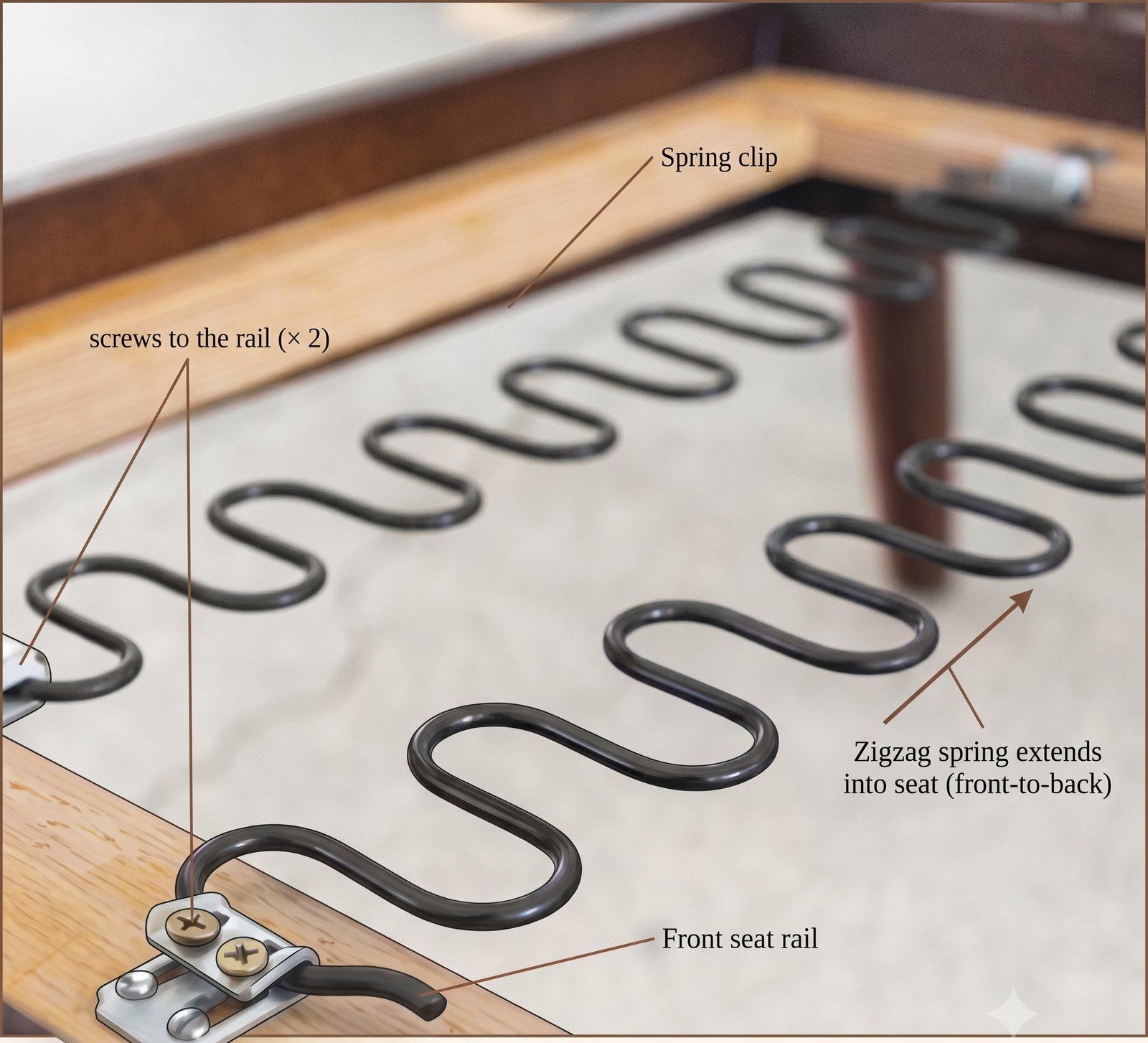
Fitting the clips is the slow part of the job — every spring needs two clips, and every clip needs two screws — but it's still measured in minutes per seat rather than hours. We pre-mark the clip positions on the rails before fitting any of them, so the spacing stays consistent across the whole seat.
Once the clips are screwed down, the spring is cut to length, the terminal hook is formed at each end (a quick bend with pliers), and the spring is dropped into the clips. The crimping happens last, with the spring-clip pliers (paid link), locking the spring in for life.
Working spring length is roughly the rail-to-rail dimension plus 30% — the extra is what gives the spring its arched rise and the seat its “give”. Cut a spring to exactly rail-to-rail and the seat will feel rigid.
Tools & materials for this job
- Zigzag (sinuous) springs (paid link)
- No-sag spring clips (paid link)
- 25 mm wood screws (paid link)
- Heavy wire cutters or bolt cutters (paid link)
- Spring-clip pliers (paid link)
- Waxed mattress twine (paid link) (for cross-tying)
- Dacron wadding (paid link) (to soften spring contact)
A customer brought us an Ercol three-seater from 1968 with an alarming bounce on one side. We pulled the cushions off and found two of the original Pirelli rubber straps had snapped and four others were plainly perished. The frame was too shallow for coil springs — and the original construction wasn't coil-sprung anyway — so the obvious fix was zigzag.
We fitted seven zigzag springs at 9-gauge, two cross-ties, a layer of Dacron over the top to soften the spring contact, and re-used the customer's own cushions. The job took about ninety minutes. The bounce was gone, the seat was firm and supportive, and the chair has another fifteen to twenty years in it. Zigzag is the right answer on a 1968 piece in a way it absolutely isn't on an 1868 one.
Zigzag springs are also called sinuous wire springs in the trade and in the manufacturers' catalogues. The name refers to the wave-like — sinuous — shape of the spring seen from the side: a continuous undulating S-curve rather than the discrete coils of a Pratt-style spring. The first patents for sinuous springs date from the 1920s, and by the 1950s they had largely displaced coil springs in factory-made furniture.
The trade name “no-sag” (sometimes “Nosag”) comes from a brand that became generic. Strictly, No-Sag was a trademark of the No-Sag Spring Company of Detroit, founded in 1929; like Hoover and Biro, the brand became the noun. We still call them no-sag clips at the bench.
- Springs cut too short. Cut to exactly rail-to-rail and the seat is rigid. The 30% extra is what gives the rise.
- Springs cut too long. Excessive rise puts unnecessary load on the clips and they pop free. The 30% rule is remarkably exact.
- Skipping the cross-ties. Without them the springs sway side-to-side under load and you feel the movement when you sit. Three minutes' work saves the sense that the seat is wrong.
- Wrong gauge. 11-gauge in a sofa seat is too soft; 8-gauge in a chair back too hard. Match the gauge to the load.
- Fitting zigzag to a Victorian frame. Don't. The frame's geometry is wrong for it, the look will be off, and the customer is being short-changed.
Springs in — coil or zigzag, depending on the chair. What sits on top of them is the heart of traditional upholstery: stuffing, stitched edges, and the rim that gives a seat its shape for a hundred years. Chapter 12 is the longest in this part of the book.
Rather hand this one to a professional? Find a good upholsterer near you →